For companies to remain agile, technology and automation need to be part of virtually every process, not just an afterthought or add-on.
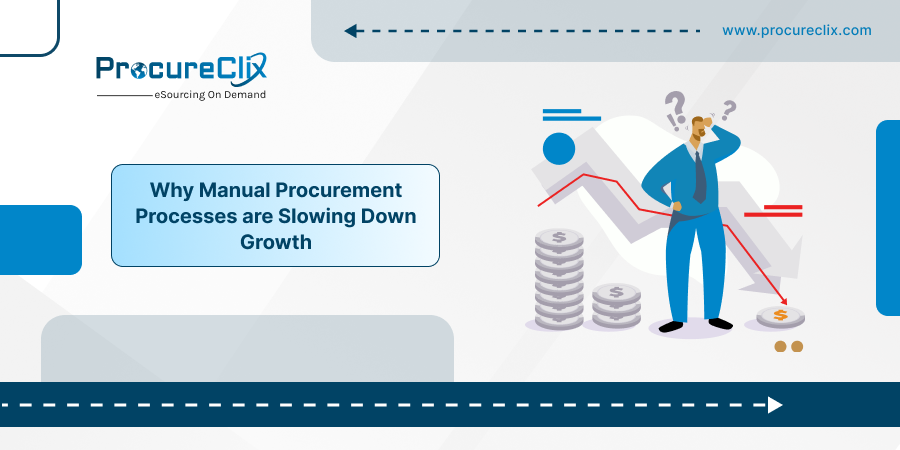
Procurement is no different, yet many organizations are still using manual procurement processes that were never meant to scale. Relying on spreadsheets, email chains, and paper-based approval processes creates friction at every touch point.
The obvious effects of this are processing delays and administrative overhead. But more importantly, these manual procurement processes prevent businesses from capturing market opportunities, optimizing spend, and building more resilient supply chains.
In this article, we’ll outline exactly where manual procurement processes are slowing down organizations, and offer technology solutions you can implement for immediate efficiency gains.
Processing Time Bottlenecks and Cycle Time Inflation
Manual procurement processes have an inherent latency at every stage of the source-to-pay cycle. Manually creating RFPs, RFQs, and RFIs can take up to four weeks due to email lag times or the consideration of spreadsheets across different departments.
In a manual workflow, every handoff creates its own delay. Waiting on replies or approvals, manual cross-referencing, and reconciliation each impart its own procurement delays.
In this situation, purchase orders require manual data entry and cross-referencing against contracts, and invoice reconciliation becomes a detective exercise of matching line items across disparate systems.
Many organizations get lulled into thinking these built-in delays are manageable when volumes are low enough. At 50 purchase orders a month, these delays may seem easy enough to absorb. But when you scale, the delays increase exponentially, not linearly.
This cycle inflation is what catches most organizations off guard. A system that had worked is now a nearly failing system despite the organization growing and being successful in other areas.
Getting cycle time inflation under control is the key benefit of e-procurement tools such as ProcureClix. ProcureClix’s multi-level approval hierarchies leverage conditional logic to route requisitions based on spend thresholds, cost centers, and commodity codes.
Purchase orders no longer sit in the approval queue due to multi-department approval or a decision maker being unavailable via email. The system immediately reroutes the approval based on predetermined conditional logic. Mobile approval also means procurement team members can approve from anywhere.
For high-growth organizations, cycle time compression translates directly to a competitive advantage. Four-week processes are now compressed into 48 hours, all with complete audit trails.
Smart teams address cycle time inflation by using e-procurement workflows before bottlenecks start impacting agility and growth.
Spend Visibility Blind Spots and Strategic Decision-Making Gaps
Cycle time inflation has a cascading effect that creates opacity in spend data, undermining strategic decision-making. This problem goes beyond just delays and starts to impair other fundamental business goals outside of procurement.
As purchase orders are scattered across departmental spreadsheets and contracts are stored in shared drives without standardized nomenclature, procurement teams lack a unified view of organizational spend.
Suddenly, supplier consolidation opportunities, contract compliance rates, maverick spending patterns, and category-level price variance all become nearly impossible to track accurately.
Teams that don’t have access to real-time, accurate procurement data are operating reactively, instead of being strategically proactive. Without real-time visibility into spend across locations, departments, vendors, and categories, organizations cannot identify the up to 40% of addressable spend that often exists in fragmented, non-compliant purchases.
AI-powered analytics, like those found in ProcureClix, aggregate and classify procurement data in real time. The platform’s custom dashboards provide complete visibility across all locations, departments, vendors, and categories. This allows procurement teams to identify consolidation opportunities, track contract utilization, and detect maverick spending as it occurs.
By having every transaction captured in a unified system, you can start to leverage predictive analytics across your supplier list. Using this proactive approach, you can identify supplier risk before it materializes, negotiate volume discounts based on actual consolidated spend, and optimize category strategies with empirical data.
If your organization is pursuing strategic procurement transformation, spend visibility is the most critical insight required. There is no way to achieve this through the use of manual procurement methods, and it’s why manual procurement processes have cascading effects that ripple through an entire business.
Supplier Relationship Management Inefficiencies
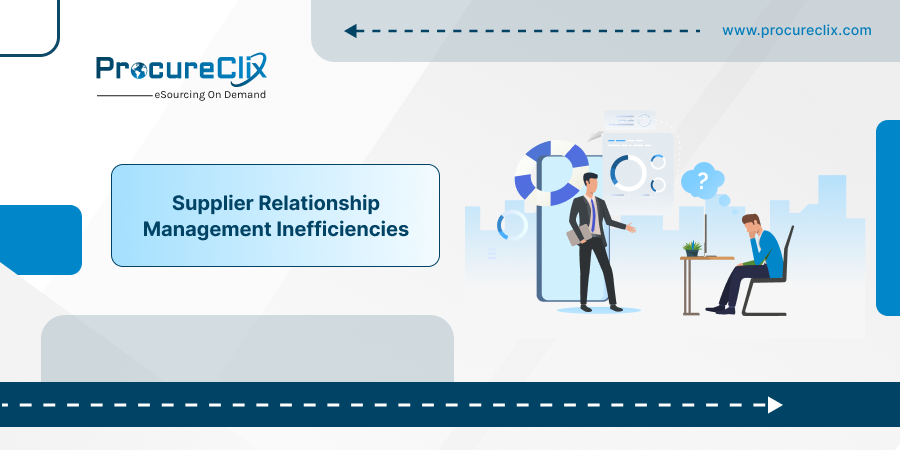
It’s not just your internal business operations that are impacted by inefficient manual procurement processes. Your supplier relationships are also negatively affected due to slow onboarding.
Each new supplier represents dozens of person-hours in administrative work. This friction creates a tendency to remain with current suppliers despite evidence that bringing in a new supplier can reinforce your supply chain or reduce costs.
Even worse, with manual procurement processes, you may not even have the proper insight to score supplier performance. Without automated supplier scorecarding, procurement teams lack systematic visibility into supplier delivery performance, quality metrics, and responsiveness. Performance evaluations often become sporadic and highly subjective, typically triggered only when problems arise.
This is the recurring theme with manual procurement processes and how they force businesses to become reactive. In this case, the business has no predictive analytics to identify at-risk suppliers before delivery failures impact operations. There’s also no empirical foundation for supplier development initiatives or strategic partnerships.
Switching to a robust e-procurement solution addresses these limitations through automated supplier onboarding workflows and comprehensive supplier performance scorecards.
For example, ProcureClix’s collaborative supplier portals streamline communication and document exchange, reducing onboarding time from weeks to days.
But onboarding speed is just one example of the immediate benefits businesses can realize. Additional tools, such as real-time supplier risk management, help you automatically track financial stability, regulatory compliance, and operational performance indicators. You can then set automated alerts for when risk thresholds are exceeded.
Without adding extra overhead, your procurement team is now able to stay ahead of supplier issues and make adjustments before disruptions occur.
Ultimately, manual procurement processes force businesses to maintain artificially narrow supplier bases. This creates significant growth constraints, supply chain fragility, and limits negotiating leverage.
Compliance, Risk, and Audit Trail Vulnerabilities
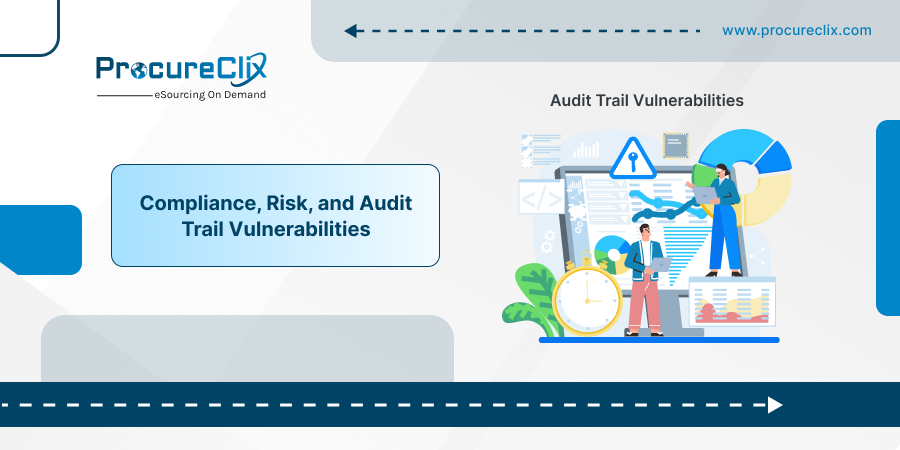
One reason procurement teams may be hesitant to expand their supplier base is the risk of complex regulatory compliance. Existing manual processes lack the controls necessary to ensure consistent compliance, and they’re also prone to human error.
The right procurement platform can give you immediate access to enterprise-grade compliance infrastructure through centralized contract repositories with automated tracking of critical dates, obligation milestones, and compliance requirements.
With ProcureClix, built-in audit logging creates immutable records of every procurement transaction and approval. Role-based access controls help enforce the separation of duties and spending authorities.
With complete ISO 27001 compliance, ProcureClix ensures that sensitive procurement data is protected according to international security standards, while automated compliance reporting reduces the burden of regulatory filings and internal audits.
The result is that procurement teams are now free to explore new suppliers across regions without hesitation.
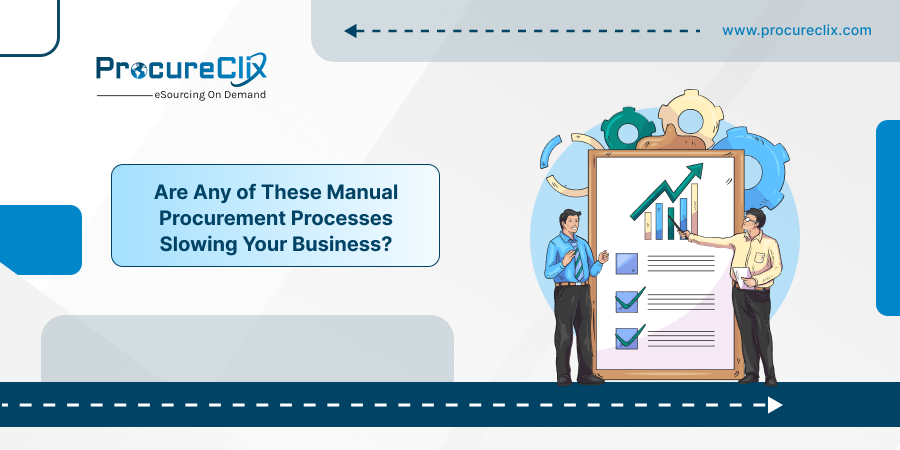
Are Any of These Manual Procurement Processes Slowing Your Business?
If your procurement teams are still using manual procurement processes or paper-based procurement, it’s time for an upgrade.
With ProcureClix, you get immediate access to the latest e-procurement tools in a single, unified platform that uses the latest AI and machine learning to keep you one step ahead of supply chain constraints.
Contact our procurement experts today to set up your free demo of ProcureClix.