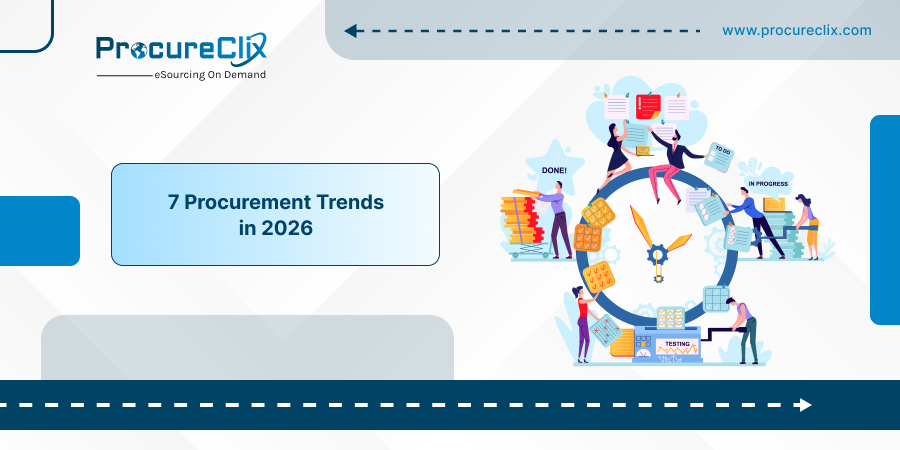
Procurement functions have never operated under as much pressure as they do today. But with that pressure, there is a potential for strategic leverage that smart teams can begin to unlock.
The teams succeeding in 2026 aren’t reacting to these various pressures as they become apparent. The best teams are operating proactively as these trends emerge, and building procurement processes that can not only withstand these pressures, but also provide operational advantages over slower-moving competition.
To help you be more proactive in responding to emerging procurement pressures and volatility, these are our top 7 procurement trends that will take shape in 2026 and beyond.
1. Agentic AI Moves From Pilot to Production
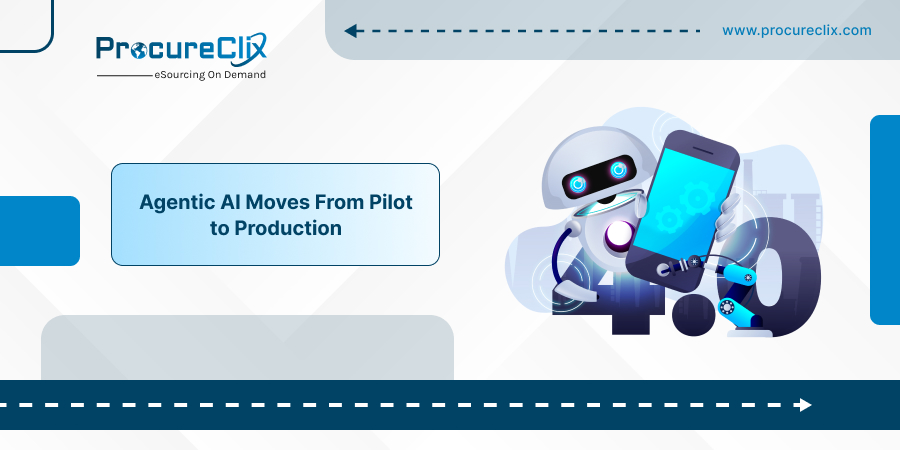
Despite AI grabbing all the headlines for much of the past two years, its real impact on business is still somewhat of an x-factor.
The most significant aspect for procurement teams is the shift from generative AI tools to agentic AI tools. In short, agentic AI acts on an operator’s behalf. For example, agentic AI can autonomously perform supplier evaluations, monitor contract milestones, flag risk signals, and process routine purchase orders without human intervention.
Agentic AI is still in the early phase when it comes to procurement, but this doesn’t mean that teams can simply stand by and wait for it to improve.
Agentic AI, regardless of how advanced it is, requires clean data and well-defined process structures. Teams running manual operations dependent on an array of spreadsheets, email chains, and siloed data won’t be able to leverage agentic AI, now or in the future.
Those with clean, structured procurement platforms will unlock compounding efficiency gains as the first agentic AI tools become available and as they improve.
2. Total Cost of Ownership (TCO) Replaces Lowest Cost Logic
The era of awarding business to whoever quoted the lowest unit price is functionally over for sophisticated procurement teams. In 2026, TCO frameworks are quickly becoming the standard methodology for sourcing decisions across categories.
The shift isn’t just a trend. It was brought on by hard lessons learned regarding supply chain disruptions, quality failures, and logistical volatility that left many organizations stressed when their low-cost options turned into significant expenses.
Smart procurement teams are now scoring suppliers across a TCO framework that includes unit price, logistics costs, lead time variability, quality performance history, financial stability, and ESG risk.
To prepare for this trend, category managers should focus on more rigorous supplier scorecards and ensuring that RFx processes are structured to capture and compare multi-dimensional value, not just the lowest upfront cost.
3. Real-Time Supplier Risk Management
With geopolitical volatility, tariff changes, climate events, and cyber threats operating simultaneously, periodic supplier risk reviews are simply indefensible.
For 2026, proactive teams are implementing continuous monitoring to track suppliers. This includes financial health, exposure to sanctions, regulatory risk, and other factors.
This is also an area where generative AI tools can work by ingesting news feeds, weather data, and financial reports to spot early warning signs before your supply chains are impacted. However, this is a large operational shift, so it’s not something that can be layered on top of outdated processes.
To prepare, teams should focus on structuring their day-to-day supplier management with clear escalation thresholds. With proper structuring, emerging AI tools can be more easily deployed to read outside data and apply it to your specific escalation and risk thresholds.
4. Tariff Volatility is Driving Sourcing Strategy Overhauls
For procurement teams managing internationally sourced categories, 2025’s tariff landscape was a stress test. 2026 is now about implementing strategies to mitigate the risks found during the initial phases of a tariff landscape.
Tariffs are more than just a cost issue. They also represent the structural volatility of the tariff policy itself. Tariff start dates, negotiations, tariff pauses, and other changes can make this an almost unpredictable factor.
Procurement teams are responding by conducting formal scenario planning exercises, stress-testing category supply chains against multiple tariff configurations, and diversifying supplier bases to reduce single-country exposure.
The practical application of this is to focus on competitive sourcing activity. Instead of “locked-in” supplier relationships, teams are running fresh RFx events to qualify alternatives in different regions, or nearshoring.
The ability to execute fast, structured competitive sourcing events and compare bids with full landed-cost transparency has become a core operational requirement for 2026.
5. Digital Procurement is Now the Baseline
While this isn’t quite a prediction, it’s an important acknowledgment of how things have changed and what it means moving forward. Digital procurement should no longer be seen as an initiative. In 2026, it’s the operational default.
Organizations still managing sourcing through email threads, purchase orders through spreadsheets, and contract renewals through calendar reminders are operating at an accelerating structural disadvantage.
E-procurement platforms and cloud-based sourcing tools now provide capabilities that were enterprise-only five years ago. Features such as real-time spend visibility, automated approval workflows, competitive bidding infrastructure, contract lifecycle management, and ERP integration are accessible to mid-market teams at a fraction of legacy implementation costs.
What makes this important in 2026 and beyond is that procurement is becoming more difficult and requires more agility. Headcounts can’t fix this problem.
It requires automation, combined with data structuring that works with future automations that are being developed every day.
Modern procurement platforms help to prepare your processes, data, and organization so you can leverage the latest automation advancements as soon as they become available, with minimal deployment time.
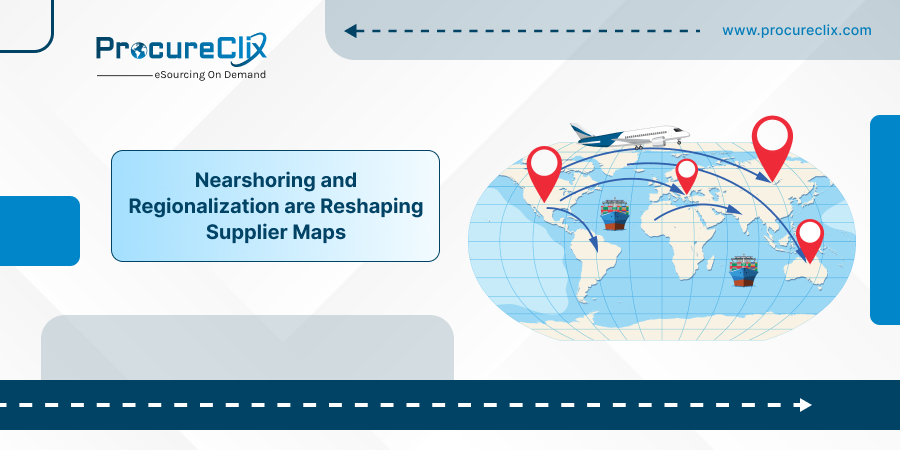
6. Nearshoring and Regionalization are Reshaping Supplier Maps
In 2026 and beyond, globally optimized supply chains built purely by cost arbitrage will start to give way to more deliberate supply chains that balance cost with resilience, compliance, and geopolitical alignment.
Nearshoring, friend-shoring, and ally-shoring have now moved from risk management strategies to becoming mainstream sourcing practices.
The drivers of this change are mostly structural. Access to critical materials and rare earths is increasingly being weaponized as geopolitical leverage. Export controls and sanctions are becoming increasingly common tools in negotiations between nation-states.
Proactive teams are responding by diversifying supplier geography, qualifying regional alternatives for strategic categories, and building multi-source capability where single-source reliance previously existed.
The practical steps for category managers are to actively maintain a broader qualified supplier base. Using current automation workflows in e-procurement platforms, this can be done without adding administrative overhead or increasing headcount.
7. The role of the CPO is Becoming Indistinguishable From Enterprise Leadership Roles
This is one of the few predictions that isn’t based on technology, and is instead based on organizational necessity. The CPO is increasingly operating with the mandate and scope of a business unit executive, not a functional head.
This evolution reflects what procurement now controls. This encompasses cost structure, supply chain resilience, AI infrastructure vendor relationships, ESG compliance exposure, and supplier-driven innovation pipelines.
For procurement professionals, the implications of this are the same. While traditional procurement skills are still needed, there is a premium being put on data fluency, cross-functional influence, and the ability to translate procurement intelligence into board-level strategic decisions.
The Common Theme
All of our predictions are based on the premise that procurement teams will be asked to do more, all while the landscape is growing ever-more complex and volatile.
While this seems daunting, a second theme is also present. Teams that prepare their processes and data today so that they can easily translate to coming changes will be the leaders when the inevitable disruptions come to pass.
If your organization is looking to streamline data, RFx, and other critical processes, contact our procurement professionals at ProcureClix. Our e-procurement solutions instantly modernize your processes with true data centralization, cloud scalability, and growing AI tools to streamline events.
Contact us today to learn more and receive a free customized demo to experience ProcureClix first-hand with your team.