Procurement teams that spend a disproportionate amount of time on process administration instead of strategic sourcing are likely suffering from a lack of automation.
Manual approval routing, disconnected RFx cycles, contracts buried in shared drives, and spend data locked in ERPs are all areas that create compounding inefficiencies and require manual intervention at each step.
The technology to fix these inefficiencies has matured considerably. Today, the question for most organizations is how to analyze their current procurement situation and find the right automations to create immediate improvements.
In this guide, we’ll walk you through the steps to achieve optimized procurement workflow automation using the latest tools and techniques.
Diagnosing Your Workflow Maturity Before You Automate
Haphazardly applying automation won’t provide the necessary workflow efficiencies that you’re going for. Unfortunately, many procurement solution platforms push this strategy, and it’s far too generic to create optimized results.
Before selecting a platform or defining an implementation roadmap, investigate where your procurement workflow currently breaks down.
Look for things like approval queues that stall on individual out-of-office status, or RFQ cycles that require manual email follow-ups with suppliers. Another common area where manual workflows break down is contract renewals that are discovered after the fact, leading to renewed terms without renegotiation.
There’s also spend reporting that takes days to compile because data lives across multiple systems.
Procurement activities typically fall across four tiers:
- ad hoc
- Repeatable
- Defined
- Optimized
Many organizations will find workflows that fall into the second tier, where processes exist, but they’re person-dependent and not system-enforced.
The goal is then to bring these into tiers three and four, where they are clearly defined, enforceable within the automation structure, and customizable for continuous improvements.
In the next sections, we’ll look at the most common areas that fall into tier two and how you can start to automate them.
Automating Purchase Requisition and Approval Workflows
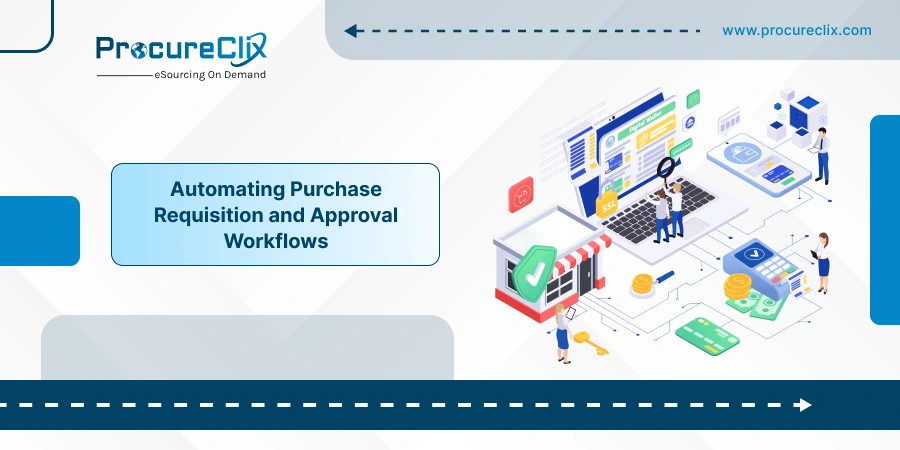
The purchase requisition is the entry point of your procurement cycle and frequently its most chaotic component. In manual environments, PRs travel through email chains with no audit trail, and approval authority is mostly enforced through organizational channels and culture.
This all makes budget visibility retroactive at best.
To start automating PR workflows, you need to encode your approval logic directly into the platform that you’re using. For example, spend thresholds that trigger tiered authorization or commodity categories routed to specific approvers.
Other areas of easy automation gains include budget checks executed in real time against allocated spend, and buying channeled through pre-approved supplier catalogs at contracted prices.
The result of automating these processes is that you get a system that’s compliant structurally, not just when workers decide to follow the guidelines.
Platforms like ProcureClix implement this type of necessary automation through configurable, role-driven approval routing systems with real-time spend limit controls. This guarantees that a requisition either moves forward within defined parameters or is escalated with full visibility.
Buying from preferred suppliers at contracted prices is also enforced automatically at the point of requisition, which closes the maverick spend loophole before a PO is ever issued.
Modernizing the RFx Process
The RFI/RFQ/RFP cycle is where manual procurement processes start to substantially increase your administrative burden. Without a structured platform, your sourcing teams spend a significant amount of time normalizing supplier responses before any comparison analysis can begin.
Modern e-Sourcing platforms address this at every stage of the cycle through automation. On the front end, templated bid forms enforce response structure. Suppliers answer the same questions in the same format, which makes side-by-side comparison by your team easy.
With parallel supplier communication replacing things like email threads, you’re able to compress cycle time and eliminate the risk of inadvertently sharing one supplier’s position with another.
On the back end of the process, you can automate scoring and weighting so that evaluation is driven by a defined methodology rather than subjective assessment.
To implement this, tools like ProcureClix offer a custom RFP module that’s built around this structured sourcing model.
Covering RFI, RFQ, and RFP processes within a single e-sourcing environment, with built-in quote comparison tools and collaboration functionality that allows multiple stakeholders to evaluate and score responses without managing that process outside the system.
For most organizations that are looking to replace manual workflows, this is typically the highest-impact automation they can implement.
Competitive Bidding Through Reverse Auctions
Reverse auctions are a type of automation that works best in specific areas. These are usually areas where commodity or near-commodity categories with multiple qualified suppliers are sourced.
Essentially, where price is the main driver, and specifications are well-defined.
Using reverse auctions in these situations compresses the negotiation cycle and applies competitive pressure that a sealed-bid RFQ cannot replicate.
Implementing reverse auctions with automation can also be easy, even for teams new to the technology. ProcureClix’s reverse auction module supports the full event lifecycle, from quick auction setup to post-event analysis, with an interface designed for supplier participation without formal training or complex onboarding.
Organizations running regular reverse auction programs across MRO, logistics, energy, and indirect categories have reported savings of 10% or more on addressable spend.
Automating The Contract Lifecycle
Contract management is another area where there is plenty of low-hanging fruit where automation can help achieve immediate efficiency improvements.
Organizations frequently have no systematic approach to what happens after a contract is signed. The contracts live in email archives, network folders, or a single person’s file structure. Critical information, like renewal dates, is then tracked in a spreadsheet that may or may not be current.
A contract lifecycle management module brings discipline to the post-award phase. The core requirements are a centralized repository with indexed search, version control, and a full audit trail of changes. This also includes automated renewal and expiration alerts triggered by configurable lead times, and e-signature integration that eliminates the print-sign-scan cycle.
In addition to acting as a repository, there’s also the dashboard aspect for quick contract review. Visibility into total contracted value by category, supplier, location, and department gives category managers the context to make renewal and renegotiation decisions proactively rather than reactively.
Spend Analytics as a Control Layer
To have effective spend analytics, your workflows require three things.
- Clean, classified data
- Flexible visualization
- KPIs connected to your procurement objectives
Data classification with a standard taxonomy is the most foundational step. Once data is classified, integrating BI tools like Power BI and Tableau with your e-sourcing platform can find savings, supplier consolidation opportunities, maverick spend by department, and category-level price trend analysis.
One problem is that proper classification can often require a dedicated analytics team. However, modern procurement platforms can help with this by using automated data aggregation, classification, and normalization.
This puts the true power of analytics within reach of teams that previously didn’t have the resources to unlock the full potential.
Start Automating Your Procurement Workflows Today With a Free Demo
ProcureClix is the premier e-procurement platform that allows procurement teams to automate processes faster and easier than they thought possible.
Contact our procurement experts today for a free, customized demo that will allow you to explore our full suite of automation tools and workflows.