

Key Takeaways
|
Introduction
Energy is one of the few categories where you cannot pause consumption while you shop. The furnace stays hot, the compressors run, and the refrigeration units stay cold. An energy procurement strategy is how you decide, in advance and in writing, what you buy, when, from whom, and under what terms, instead of accepting whatever the calendar hands you.
The right answer is rarely “lock in a fixed rate” or “buy on the spot market.” It depends on your facility load, budget tolerance, contract timeline, and operational flexibility. A three-shift manufacturer carries a very different risk profile from a distribution center that can shift charging or refrigeration load outside its peak window. This guide covers seven steps, written for electricity and natural gas and adaptable to fleet fuel, propane, and steam.
What Does an Energy Procurement Strategy Mean?
An energy procurement strategy is a documented plan for how your organization buys electricity, natural gas, fuel, and renewable energy while managing price risk, contract obligations, demand, and sustainability goals. Know what you use, when you use it, and what you are contracted to buy. Then source the right portfolio, govern the contracts, and keep actual consumption connected to the plan.
The two terms are not interchangeable. Energy purchasing is the transaction. Energy procurement is the whole discipline: market analysis, sourcing events, contract structure, supplier management, demand planning, and performance review after signature. For a fuller walkthrough of the basics, see our guide to how energy procurement works.
A usable strategy answers six questions in writing: what do we buy, when, from whom, under what pricing structure, who owns the decision, and what happens if usage changes? If you cannot answer all six, you have a contract rather than a strategy.
Why Buying Energy As Needed Costs More Than It Looks
Buying “as needed” in a category you cannot switch off means accepting the price and terms the calendar offers. Two things make energy unusual:
- Rates can move inside a single buying window. The number you budgeted in February may not exist by April.
- Your own demand drives spend as much as the supplier’s price. A strong unit rate still blows the budget if production runs hot.
Volume is where much of the avoidable damage happens. A plant signs an agreement sized to expected production, and six months later a line moves to another facility. Depending on the terms, that means take-or-pay exposure, shortfall penalties, or a tolerance band that was never wide enough. The rate was fine. The demand assumption was wrong.
Market conditions add pressure. The IEA’s Electricity 2026 report (February 2026) forecasts global electricity demand growing about 3.6% a year through 2030, faster than the global economy, and continues to flag affordability as a concern in many countries. That is context, not a forecast, but it argues against handling energy as a last-minute renewal.
Every strategy balances four goals: cost control, supply and price risk, operational fit, and sustainability commitments. They pull against each other: a fully fixed contract buys certainty but forgoes market declines, while a fully indexed one keeps flexibility but hands your budget to the market. The useful conversation is about where in between, and who decides.
The process adds friction too. Bid files land in three inboxes, approvals live in email threads, and the negotiated volume tolerance lives in someone’s notes. Cloud-based e-sourcing consolidates supplier communication, documents, and bid evaluation in one place, so the next renewal starts from the record instead of rebuilding it.
How to Build an Energy Procurement Strategy in Seven Steps?
Steps one through four happen before you go to market. Steps five through seven cover the pricing decision and everything after.
- Map usage and contract exposure
- Set objectives and decision rights
- Segment by market and load profile
- Run a controlled sourcing event
- Choose a pricing structure
- Negotiate the protective terms
- Govern performance after signature
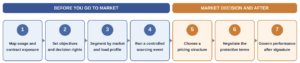
The seven steps of an energy procurement strategy
1. Map Energy Spend, Usage, Sites, and Contract Exposure
Pull 12 to 24 months of invoices, interval meter data, tariff sheets, and, where available, production volumes. Twenty-four months separates a weather year from a demand trend. ProcureClix spend analysis can consolidate invoice data from AP vouchers and other sources. Then build a contract calendar: one row per contract with supplier, site, annual volume, pricing basis, start and end dates, notice deadline, volume tolerance band, and termination rights.
Invoice spend alone misleads. Say, hypothetically, a plant spent 11% less on electricity last year. It may simply have run fewer shifts. Spend shows what left the bank account, not whether the agreement performed.
2. Set Sourcing Objectives and Decision Guardrails Before Going to Market
Agree in writing how much budget variance leadership will accept. Decide whether to lock a term, buy in tranches, or carry indexed exposure, and specify sustainability needs precisely, because “green where possible” is not a sourcing requirement. A workable split of decision rights: finance owns budget tolerance, operations validates demand, sustainability defines the renewable requirement, and procurement runs the process and owns governance. Write it down before the first bid lands.
3. Segment Sites by Market and Load Profile
Not every site gives you the same options. In states that have restructured their electricity markets, eligible customers can choose a retail supplier while the local utility keeps delivering the power (U.S. Energy Information Administration). Choice is generally limited to customers of investor-owned utilities and sometimes to non-residential accounts, so confirm eligibility site by site. Competitive sites can run a genuine sourcing event. Regulated sites shift to tariff review, rate-class verification, demand management, and billing accuracy.
Load shape matters just as much. A 24/7 process plant with steady baseload is straightforward to price. A refrigerated warehouse with sharp peaks from HVAC cycling and forklift charging is not, because peaks are where demand charges live.
4. Run a Controlled Energy Sourcing Event
Prequalify suppliers on market licensing, coverage, financial stability, renewable products, and usage-data quality. Give every bidder the same inputs: site list, load data, start dates, credit terms, renewable requirements, and pricing assumptions. If suppliers price off different load files, you are collecting opinions, not running a competition. Score total expected cost under your actual load, not the headline rate.
What to ask suppliers before award
| Evaluation area | Question to ask |
|---|---|
| Pricing structure | Is pricing fixed, indexed, capped, or blended? Which charges are pass-through? |
| Volume terms | What happens if load falls or rises by 15%? |
| Term and notice | When does pricing start, and what are the renewal notice dates? |
| Renewables and service | What certificates or reporting are included, and who handles billing issues and usage data? |
A structured RFx workflow with weighted scoring and side-by-side comparison preserves bidder communications and scoring rationale, which matters when someone asks six months later why the second-lowest bid won. A reverse auction fits only the most standardized version of the event: one product, one term, one volume band. Events can run self-managed or fully managed.
5. Choose a Pricing Structure That Fits Your Risk Tolerance
It depends on how much budget variance you can carry. An energy pricing structure is the contract mechanism that sets how your price changes over the term, a separate decision from which supplier you pick. What follows is education, not financial advice. Involve finance, legal, and a qualified market adviser before committing material volume.
- Fixed-price contracts: The supplier sets a commodity price for an agreed term, subject to listed exclusions and pass-throughs, so “fixed” rarely means every invoice line is fixed. Best fit: a manufacturer with a firm annual budget. Buyer consideration: you are protected against increases and locked out of decreases.
- Indexed contracts: Price follows a published index plus negotiated fees and pass-throughs. Best fit: a sophisticated user with market visibility and the governance to monitor exposure monthly. Buyer consideration: transparent is not the same as predictable.
- Layered buying locks portions of expected demand at different times and leaves the rest exposed to market pricing. An illustrative shape, not a recommendation: 25% locked at each of 12, 9, and 6 months before delivery, with the rest bought closer in (hypothetical figures). The cost is governance. Someone must own the trigger dates and report the blended position, or it quietly becomes “we forgot to buy the last tranche.”
6. Negotiate Contract Terms That Protect You From Cost Surprises
Four clauses do most of the protecting. Store the executed agreement where renewal dates and negotiated terms stay visible: the ProcureClix contract management module keeps contracts in a central repository with automated renewal alerts, which beats a shared drive folder.
- Volume flexibility: Check the tolerance band, pricing on excess volume, shortfall exposure, and mechanics for adding or removing sites. If a plant moves a line to a sister facility in month eight and the contract is silent, the answer is usually “no, and you will pay for the shortfall.”
- Pass-through and change-in-law language: Ask which costs the supplier can add later and what evidence they must produce: taxes, transmission and distribution, capacity and balancing charges, market-rule changes. Have legal and finance review any clause that transfers undefined future costs.
- Renewal, termination, and notice dates: Miss a deadline and you can roll into an auto-renewal or holdover rate you never negotiated. Set alerts at 180, 120, 90, and 60 days, adjusted for the notice period and how long a sourcing event takes.
- Data, audit, and dispute rights: Require timely usage data, line-item invoice detail, supporting calculations, and a dispute process with response timelines. Capture rate mechanics in the contract record, not the negotiator’s memory.
7. Govern Performance and Control Costs After the Contract Is Signed
Sourcing sets the price. Consumption, billing accuracy, and supplier performance over the next 12 to 36 months decide the bill. Three levers matter most.
- Track performance against consumption. Each month, compare contracted assumptions, actual consumption, throughput, and the invoice. Split variance into market price, volume, tariff, and operational demand, so “energy overspend” tells leadership and operations something useful. Run it as a short monthly review with procurement, finance, and site operations.
- Cut demand before buying more supply. Identify the expensive demand windows at each site and test whether schedules, storage, charging, or noncritical processes can move out of them. Shifting compressed-air tasks or forklift charging can cut the demand component of the bill without changing output, where operations confirms it is feasible. Also check whether demand response programs, which pay customers to reduce use during high-demand periods, conflict with production commitments.
- Govern suppliers and renewals from one record. Score suppliers on invoice accuracy, data timeliness, response time, contract compliance, and renewable documentation, using supplier performance scorecards. When the renewal date and supplier correspondence live with one person, a role change can cost weeks of negotiating runway. We built ProcureClix so supplier communications, documents, bid responses, scoring, and approvals sit in one audit-ready workflow, so the next renewal starts from evidence instead of archaeology.
Metrics for Measuring an Energy Procurement Strategy
A lower unit rate is one input, not the scorecard. These measures show whether the strategy is working:
| Metric | What it shows | Cadence |
|---|---|---|
| Energy cost per unit of production | Spend relative to business activity | Monthly |
| Budget-to-actual variance | Financial predictability | Monthly |
| Contracted vs. actual volume | Penalty or missed-savings exposure | Monthly |
| Invoice exception rate | Billing accuracy and AP workload | Monthly |
| Renewals completed on time | Contract governance discipline | Quarterly |
| Renewable attribute coverage | Progress against stated targets | Quarterly or annually |
Normalize for production changes, weather, and operating hours. Otherwise a mild winter looks like a procurement win.
Common Energy Procurement Mistakes and How to Fix Them
Four mistakes recur in energy sourcing. Run this check before your next renewal or sourcing event, not after.
| Mistake | What it costs you | The fix |
|---|---|---|
| Awarding on the lowest quoted rate | Pass-throughs and tight volume terms show up on the invoice, not the bid sheet | One standard comparison sheet and cross-functional review before award |
| No operational validation of demand | Contracted volume stops matching how the site runs | Documented sign-off from the operating site |
| Unowned renewal dates | Auto-renewal or holdover pricing you never negotiated | One named owner, one approval path, early reminders |
| Renewable goals handled separately | Claims retrofitted after award, or an unbudgeted premium | Renewable requirements written into the bid package |
Operations knows first. Shutdowns, expansions, and fleet refreshes reach the operating plan months before procurement. The rule: no energy contract award without documented demand validation from the operating site, even if it is one email from the plant manager.
Renewables belong in the bid package. A public emissions target does not translate itself into a contract clause. Specify eligible products, verification documents, attribute ownership, Scope 2 reporting fields, and the approved premium as a number.
How to Get Started With an Energy Procurement Strategy This Quarter
Start with the inventory, then the decision rights, then the market.
- Build the contract and site inventory: renewal dates, annual spend, usage data, and pricing basis. Note the documents you cannot find.
- Meet with finance and operations: agree demand assumptions, acceptable variance, and who approves what before anyone talks to a supplier.
- Classify each site: competitive or regulated, plus load shape and operating constraints.
- Choose the right event for each opportunity: a full RFx, a supplier performance review, or a mid-term renegotiation.
- Put governance in place before the agreement starts: contract calendar and monthly review.
Conclusion: Turn Energy Spend Into a Category You Control
An energy procurement strategy does not have to start as a trading program. Most of the value sits in clear data, clear decision rights, and contract discipline. Map your exposure first, then source and govern the contracts the way your sites actually run. You can book a ProcureClix demo to see the workflow on your own site list.
Frequently Asked Questions About Energy Procurement Strategy
What is an energy procurement strategy?
It is a documented plan for how an organization buys and manages electricity, natural gas, fuel, and renewable energy, covering demand data, sourcing, pricing structure, contract terms, and supplier performance after signature. The goal is an arrangement that fits how your sites operate and how much variance your business can carry.
How do companies source electricity and natural gas?
They review usage, contract expiry dates, and what each site’s market structure allows. In competitive markets, procurement runs an RFx with prequalified suppliers on identical load inputs. In regulated markets, the levers are tariff selection, demand management, and billing accuracy.
What is the difference between fixed-price and indexed energy contracts?
A fixed-price contract sets a commodity price for a defined term, improving budget certainty but forgoing any market decline. An indexed contract moves with a published index plus fees and pass-throughs, offering flexibility but requiring monthly monitoring. Check the exclusions in either, because “fixed” rarely means every line is fixed.
How can procurement reduce energy costs without changing suppliers?
By validating invoices, controlling renewal dates, renegotiating unfavorable terms at the next opening, and working with operations on demand-side savings such as shifting load out of peak windows. Switching suppliers is one lever among several, and often not the first worth pulling.