

Key Takeaways
|
What is energy procurement?
Energy procurement is the business process of forecasting energy demand, selecting supply arrangements, negotiating contracts, and managing the cost, risk, and sustainability impact of electricity, natural gas, and other energy purchases.
For most commercial and industrial programs, “energy” means electricity and natural gas. Some organizations pull more into scope: diesel and heating fuel, renewable energy certificates (RECs), and vehicle-charging supply for electrified fleets.
What’s in scope should be a deliberate decision, not an accident of who happened to sign what.
The discipline breaks into three parts, and they get mixed up constantly:
- Energy sourcing: Finding and evaluating supply options, suppliers, and contract structures. The same mechanics you’d use in any competitive event apply here the strategic sourcing process doesn’t change, just the commercial variables you’re comparing.
- Energy purchasing: Executing the approved contract or utility service arrangement. This is the transactional step that puts the sourcing decision into effect.
- Energy management: Monitoring usage, invoices, demand, supplier performance, and risk after the contract is signed.
A signed supply agreement isn’t the finish line. It’s the point where contract management and operational data become critical.
That distinction carries more weight in energy than in most categories. The volume you committed to is being consumed continuously, by equipment that will change over the life of the contract.
How is energy procurement different from utility bill payment and facilities management?
Short answer: they answer different questions and sit with different owners. Bill payment confirms you were charged correctly. Facilities work makes the site use less. Energy procurement sets the commercial terms under which you buy in the first place.
| Activity | Main question it answers | Typical owner | Example at an industrial site |
|---|---|---|---|
| Energy procurement | How should we buy energy and manage price risk? | Procurement, energy manager, finance | Selecting a fixed-price electricity contract covering three plants |
| Utility bill processing | Was the invoice correct, approved, and paid? | AP, finance | Paying a monthly utility invoice after validation |
| Facilities management | Is the building or equipment operating efficiently? | Facilities, engineering, operations | Adjusting HVAC schedules or maintaining compressed-air equipment |
| Sustainability management | How do purchases support emissions goals? | Sustainability, procurement | Buying renewable electricity attributes or structuring a renewable supply agreement |
The handoffs are where programs break down. Procurement shouldn’t set an energy strategy without site-level operating data you’ll end up bidding a load shape that doesn’t exist.
And facilities teams shouldn’t be left holding commercial contract risk on their own. Volume bands, pass-through clauses, and credit terms aren’t an engineering problem.
Scale changes how you organize it. In smaller organizations, one person often wears two or three of these hats, and that works as long as the decision rights are written down somewhere.
Larger organizations tend to run a standing cross-functional energy committee procurement, facilities, finance, sustainability that meets on a set cadence. That cadence is the difference between planning a renewal and scrambling 60 days before a contract expires.
How does the energy procurement process work?
Energy procurement works as a seven-step cycle: gather data, forecast demand, confirm market structure, set risk guardrails, run an RFx, contract, then monitor and adjust. The steps don’t change much between a single-site business and a 40-site portfolio the coordination effort does.
Treat this as an operating rhythm, teams that only look at energy when a contract expires end up making a market decision on someone else’s timeline.
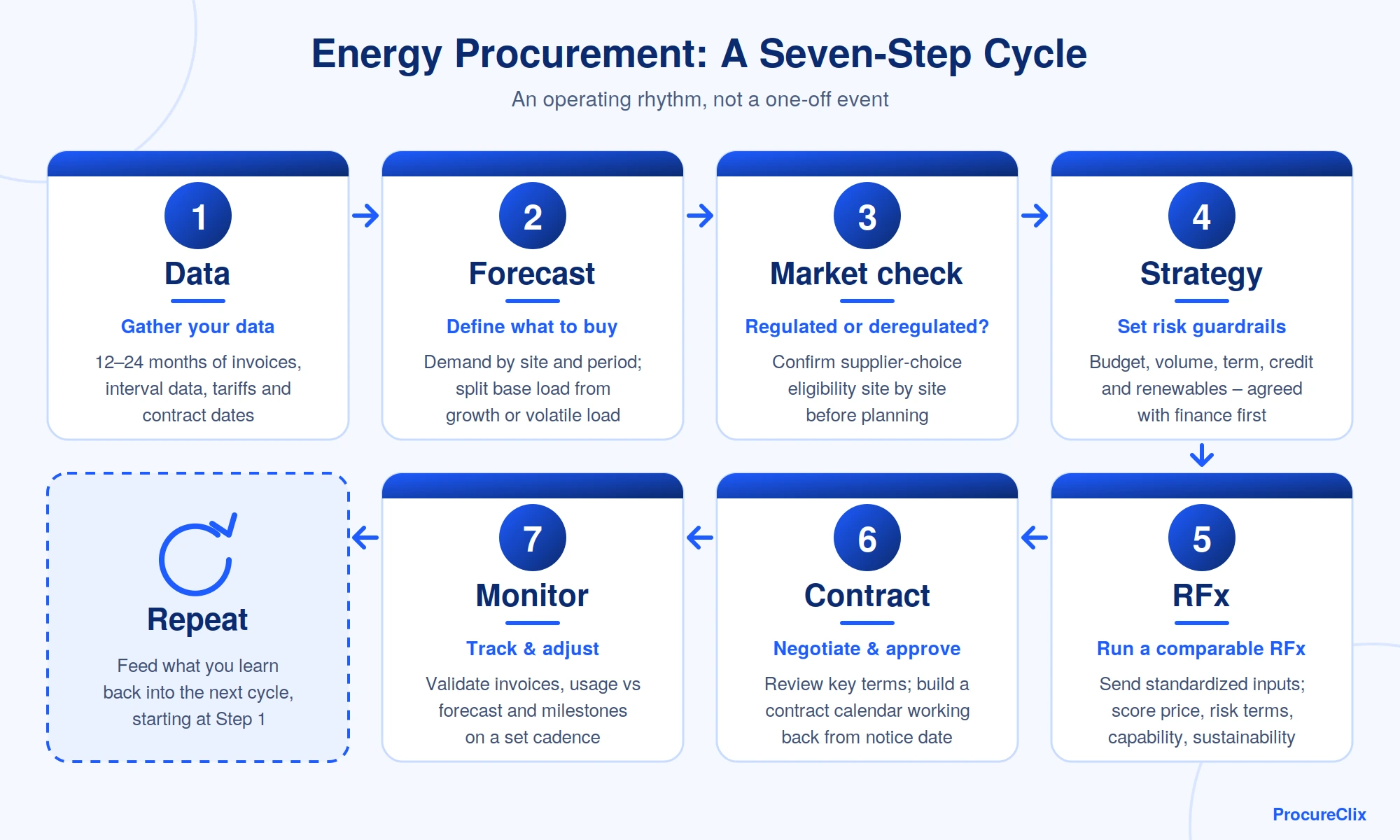
1. Gather energy, site, and contract data
Start with 12 to 24 months of history. Anything less and seasonality will fool you.
What to pull:
- Invoices: 12–24 months per account, not just annual totals.
- Interval meter data: Where available. This is what tells you your load shape rather than your volume.
- Site and account details: Exact service addresses, account numbers, meter IDs, and utility territory.
- Tariff details: The specific rate schedule each meter sits on.
- Current agreements: Supplier contracts, expiry dates, and renewal notice windows.
Then layer in the operational inputs that invoices can’t tell you: production schedules, planned shutdowns, new equipment coming online, warehouse expansion, electrification projects, and any onsite generation or storage.
Here’s the practitioner note. Invoice totals alone are usually not enough. A plant with a poor load factor and heavy demand charges has a completely different “best price” than a plant with the same annual kWh consumed at a flat, predictable rate. Bid the total and you’ll get a quote priced for a customer you aren’t.
2. Forecast demand and define what must be bought
Estimate expected electricity and gas use by site and by period. Then split it: predictable base load in one bucket, volatile or growth-related demand in another.
Your forecast will be wrong. That’s fine, the goal isn’t precision, it’s a defensible volume range that keeps you out of contract terms that penalize normal operational variation. Ordinary seasonality shouldn’t trigger a balancing charge.
Example: a manufacturer adding a second shift should update the load forecast before locking in a multi-year position. Committing to a single-shift volume and then running two is how buyers discover what sits outside their volume band.
3. Confirm whether each site is in a regulated or deregulated market
A regulated energy market is one where the utility generally provides both delivery and supply under approved tariffs. A deregulated market allows eligible customers to choose a competitive energy supplier while the utility still delivers the energy.
Rules vary by country, state, province, and sometimes utility territory. Validate eligibility site by site. A company-wide strategy that assumes every location can shop will fall apart at the first regulated plant.
| Market type | Who supplies the energy? | What procurement can influence | Common buying approach |
|---|---|---|---|
| Regulated market | Usually the local utility | Tariff selection, demand management, rate-case awareness, onsite generation, efficiency | Manage utility rates and consumption; evaluate approved programs |
| Deregulated market | Utility delivers energy; competitive supplier may provide commodity supply | Supplier selection, contract structure, term, pricing basis, renewable options | Run an RFx or negotiate with qualified suppliers |
| Mixed portfolio | Different rules by site | Portfolio strategy plus local execution | Segment sites by market and spend profile |
For U.S. sites, the U.S. Energy Information Administration (2024) publishes reference material on retail electricity choice and state-level market structures. It’s a reasonable starting point for mapping a portfolio, though you should still confirm eligibility with the utility or supplier for each account.
4. Set the buying strategy and risk guardrails
Decide what you’re optimizing for before suppliers quote. Otherwise the lowest number on the page wins by default, and low price and low risk are not the same thing.
Work through this with finance in the room:
- Budget certainty: How much annual price movement can finance absorb without a re-forecast?
- Volume flexibility: Could production changes, weather, or an acquisition move usage far enough to push you outside a volume band?
- Term length: Do you need a one-year reset, or multi-year coverage?
- Renewable-energy requirement: Is the goal cost stability, emissions reporting, renewable attributes, or all three?
- Credit exposure: What collateral or credit support might a supplier ask for?
- Approval rules: Who can approve a fix or a hedge, and who signs the supply agreement?
Get finance early, not at signature. A contract that looks attractive on unit price can still create budget volatility, credit obligations, or accounting complexity that nobody modeled.
5. Run an RFx or negotiate with qualified suppliers
An energy RFx exists to make quotes comparable. Without one, you’re comparing five suppliers who each assumed a different load shape, term, and set of pass-through charges.
Standardize the inputs you send out: usage profile by site and interval, delivery points, proposed term, load assumptions, required pricing format, renewal language, and any renewable products you want priced.
For teams managing multiple sites and bid responses, running the event in a structured RFx workspace preserves the assumptions behind each supplier quote which matters six months later when someone asks why supplier B looked cheaper.
Then evaluate on four axes, not one:
- Price: Compare like-for-like pricing mechanics, not headline cents per kWh. Confirm what’s inside the rate and what’s passed through.
- Risk terms: Volume bands, pass-through charges, collateral requirements, and early termination provisions.
- Supplier capability: Market coverage, credit standing, reporting quality, and issue-resolution process.
- Sustainability evidence: Ask specifically what documentation you’ll receive to support any renewable or emissions claim.
Where ProcureClix fits
Energy sourcing events fall apart on traceability more than on price. ProcureClix holds the usage profile, the load assumptions, and the pricing format you sent each supplier alongside their responses, so a quote comparison six months old can still be reconstructed. Multi-site buyers can run the event once and keep every renewal notice date in the same system that holds the contract.
6. Negotiate, approve, and contract
Review these items with legal, finance, and site stakeholders: pricing basis, term, renewal notice date, volume tolerance, pass-through cost treatment, force majeure, credit support, data access rights, and dispute handling.
Auto-renewal language deserves its own look. Miss a notice window and you can roll into a new term at whatever the market is doing that month usually the exact moment you’d have wanted choices.
Build a contract calendar for every agreement. Track five dates: contract expiry, last date to issue renewal notice, sourcing launch date, internal approval date, and expected decision date. Work backward from the notice date, not the expiry date.
7. Monitor performance and adjust the plan
Post-signature management covers four things: validating invoices against agreed contract terms, monitoring consumption against forecast, tracking contract milestones, and reviewing market and sustainability performance on a set cadence.
One distinction worth making internally. Monitoring the market is not trading it. Most procurement teams need defined guardrails trigger levels, approval thresholds, a decision calendar not a daily view on price direction. If your strategy requires someone to call the market correctly, it isn’t a strategy.
This is also where supplier and contract performance either gets tracked or quietly disappears into someone’s inbox.
What types of energy contracts should buyers understand?
Five structures cover most commercial and industrial buying: fixed-price, indexed or variable, block-and-index, utility tariff or default supply, and renewable supply arrangements. Names vary by market, supplier, and region, and two suppliers can use the same label for different structures.
So read past the name and ask one question: how are price risk, volume risk, and pass-through risk allocated between us?
| Contract type | How pricing works | Best suited for | Main trade-off |
|---|---|---|---|
| Fixed-price contract | Commodity price is set for an agreed term, subject to contract details | Organizations that prioritize budget certainty | You may pay above market if prices fall; terms may limit volume flexibility |
| Indexed or variable-price contract | Price moves with a published market index or utility rate | Teams able to tolerate market movement and monitor exposure | Monthly spend moves with the index, so budgets have to flex |
| Block-and-index contract | A portion of expected volume is fixed; remaining volume floats with an index | Larger users with variable load and defined risk controls | More complex to manage and explain internally |
| Utility tariff / default supply | Price follows utility-approved rates or default-service rules | Regulated markets or smaller loads with limited choice | Less ability to negotiate supply terms |
| Renewable supply arrangement | Electricity supply includes renewable attributes, often through RECs, green tariffs, or structured agreements | Organizations with documented renewable-energy targets | Claims, cost, and contract boundaries require careful review |
Four terms show up in almost every energy conversation. Worth knowing cold:
- Load factor: How consistently a site uses energy over time. A site running steadily around the clock has a high load factor; one with sharp peaks and long idle periods has a low one.
- Demand charge: A fee based on the highest level of power drawn during a defined interval, common in commercial and industrial tariffs. It’s billed on your peak, not your total.
- Pass-through charge: A cost passed from the utility, grid operator, or market to the customer under the terms of the contract, rather than absorbed in the supplier’s price.
- REC: A renewable energy certificate representing the environmental attributes of one megawatt-hour of renewable electricity generation. Eligibility and claims rules vary by program and location.
What are the biggest risks in energy procurement?
Six risks drive most energy procurement outcomes: price, volume, contract terms, operational data, supplier health, and sustainability claims. Managing them comes down to matching your contract structure to the exposure your business actually has.
A plant with stable, predictable load and a nervous CFO needs a different answer than a seasonal distribution network with an acquisition pipeline.
- Price risk: Wholesale prices, utility tariffs, transmission congestion, weather, and fuel costs can all affect what you pay, depending on how your contract allocates them.
- Volume risk: A site expansion, unplanned outage, weather shift, or production slowdown can leave you over-covered or under-covered against a committed volume.
- Contract risk: Auto-renewals, narrow volume bands, vague pass-through provisions, and credit terms create costs that never appeared in the bid comparison.
- Operational-data risk: Incomplete meter data or wrong account information leads to mispriced bids, and later to invoice disputes you lose because you cannot prove the baseline.
- Supplier risk: A supplier’s financial health, service model, and market coverage affect continuity and how quickly a billing problem gets resolved.
- Sustainability-claim risk: Renewable claims need documentation that matches the reporting framework you use. “The supplier said it was green” will not survive an audit.
If you are building a renewable strategy, two documents set the vocabulary. The CDP Technical Note: Accounting of Scope 2 Emissions (version 12.0, April 2026) covers how renewable electricity claims are reported to CDP, including the market boundary rules that determine whether a claim holds. The RE100 Technical Criteria (April 2025 release) define what makes a claim credible in the first place, covering eligible technologies, energy attribute certificate cancellation, vintage limits, and a fifteen-year commissioning limit on the assets you buy from. RE100 progress is reported through the CDP cycle, so the two sit in sequence.
Align your vocabulary with whichever framework you report under before you go to market. Retrofitting a claim is far harder than specifying it in the RFx.
How can companies make energy procurement more sustainable?
Three routes cover most of it: renewable energy certificates, green tariffs or utility renewable programs, and power purchase agreements or structured renewable deals. Which one fits depends on your market structure, your reporting boundary, and how much legal and finance support you have.
The three routes, roughly in order of complexity:
- Renewable energy certificates: Usually the most accessible option for organizations buying grid power. Quality, vintage, and geographic matching all affect whether the certificate supports the claim you want to make.
- Green tariffs or renewable utility programs: Offered in some regulated utility territories, which makes them relevant for sites where you can’t choose a supplier. Terms, pricing, and additionality differ from program to program, so check each one.
- Power purchase agreements and structured renewable deals: Longer-term, more complex arrangements typically used by larger buyers with legal, finance, and energy-market support in place. These carry real commercial obligations, not just an attribute purchase.
One nuance that gets lost. Energy efficiency and load management reduce the energy you have to procure at all. Renewable procurement changes the supply or the attributes associated with what remains.
They’re complementary, and the efficient work usually has the shorter payback. A compressed-air leak survey at a manufacturing site won’t make a sustainability report, but it reduces the load you’re buying against every hour of the contract.
If you’re building a renewable strategy, CDP (2024) and RE100 (2024) both publish guidance on renewable-electricity procurement terminology and claim eligibility. [VERIFY: confirm the current CDP and RE100 guidance editions and dates for the publishing geography.] Align your vocabulary with whichever framework you report under before you go to market. It’s much harder to retrofit a claim than to specify it in the RFx.
For teams working through this across multiple facilities, our energy and utilities procurement material goes deeper on site-level execution.
What should an energy procurement team track each month?
Track six things on a fixed monthly cadence: consumption versus forecast, cost versus budget, contract milestones, invoice accuracy, supplier performance, and sustainability evidence. If you’re standing up a program for the first time, that’s a workable starting dashboard.
- Consumption versus forecast: Compare by site, not in aggregate. Then classify the variance operational, weather-related, or a data problem. The classification matters more than the number.
- Cost versus budget: Separate commodity cost, delivery charges, demand charges, taxes, and other pass-through items where your invoices allow it. A budget miss driven by demand charges calls for a facilities conversation, not a sourcing event.
- Contract milestones: Renewal notices, expiry dates, price-fix decisions, and supplier reporting deadlines. Review these monthly even when nothing is due, because the notice date you forget is always the one that mattered.
- Invoice accuracy: Check billed rates, account numbers, meter reads, taxes, and contracted terms before payment. Wrong account data is among the most common and most fixable sources of dispute.
- Supplier performance: Response times, reporting quality, dispute resolution, and compliance with what the supplier actually committed to in the agreement.
- Sustainability evidence: File renewable certificates, program records, and supplier documentation as you receive them. Reconstructing an attribute trail at reporting time is far harder than filing it monthly.
Where energy sourcing touches several facilities, finance reviewers, and supplier contacts, centralizing contract dates, approval trails, and supplier records reduces the risk of missed handoffs. The failure mode is rarely a bad decision it’s a good decision nobody could find later.
Final thoughts: energy procurement is a business-risk decision, not just a utility transaction
Energy procurement brings procurement, operations, finance, and sustainability around the same table to make an informed decision about a material operating cost. The commercial strategy belongs to procurement, but you can’t build it without site-level load data and a risk tolerance set by finance.
If you’re standing up a program for the first time, the sequence is unglamorous and it works:
- Clean up the data. Pull invoice, meter, and account records and fix the errors before anyone quotes on them.
- Map every site. Match each account to its market structure, utility territory, and tariff.
- Write down decision rights. Name who approves a price fix, who signs the supply agreement, and who owns invoice validation.
- Build a sourcing calendar. Work backward from renewal notice dates, not expiry dates.
Be careful about what you promise internally. The right outcome might be lower cost. It might also be more stable budgets, better contract flexibility, credible renewable sourcing, or a balance of all four, and a program that delivers budget predictability during a volatile year has done its job even if the unit price went up.
If your team can explain its load, its contract exposure, its renewal dates, and its decision rules, you’ve already moved beyond reactive energy buying.
Frequently asked questions about energy procurement
What is energy procurement in simple terms?
Energy procurement is how a business plans and buys the energy it needs, usually electricity and natural gas. It covers understanding how much you use and when, choosing a supply option, agreeing contract terms, and managing cost and risk after signing. It’s broader than processing utility bills: paying an invoice is a transaction, while procurement sets the terms that invoice is based on.
What is the difference between energy procurement and energy management?
Energy procurement covers supply strategy, suppliers, contracts, and commercial risk, while energy management covers how energy is used, measured, conserved, and optimized at your facilities. The two disciplines have different owners and different questions, but strong programs connect them. Your usage pattern determines what you should buy and how it should be priced. A site with heavy peaks needs a different contract than one with flat, round-the-clock load.
How does energy procurement work in a deregulated market?
In a deregulated market, the utility typically still owns the wires and handles delivery, while eligible businesses can choose a competitive supplier for the commodity portion of electricity or gas. The buyer gathers load data, requests quotes or negotiates terms, selects a supplier and contract structure, then monitors invoices and renewal dates. Eligibility and rules vary by jurisdiction and sometimes by utility territory, so confirm status account by account rather than assuming a company-wide answer.
What is the best energy contract for a business?
There isn’t one best contract for every business. A fixed-price agreement suits organizations that prioritize budget certainty and have reasonably predictable load. Indexed or block-and-index arrangements can work for teams that can absorb market movement and have the governance in place to monitor it. The right choice depends on load predictability, risk tolerance, market access, and any sustainability requirements the contract has to support.
Can small and mid-sized companies do energy procurement without an energy trader?
Yes many mid-market organizations run a disciplined energy sourcing process without building a trading function. What they do need is accurate bill and usage data, clear approval rules, a working understanding of their local market structure, and a careful contract review with legal and finance. Outside energy-market expertise becomes more useful with complex multi-site portfolios, long-term renewable agreements, or unusually volatile exposure. If your strategy depends on someone calling the market correctly, that’s a signal to simplify the structure or bring in help.